



HEADLINE: High-Volume Oral Arguments Often Signal SCOTUS Disunity, New Data Suggests
THE BASICS:
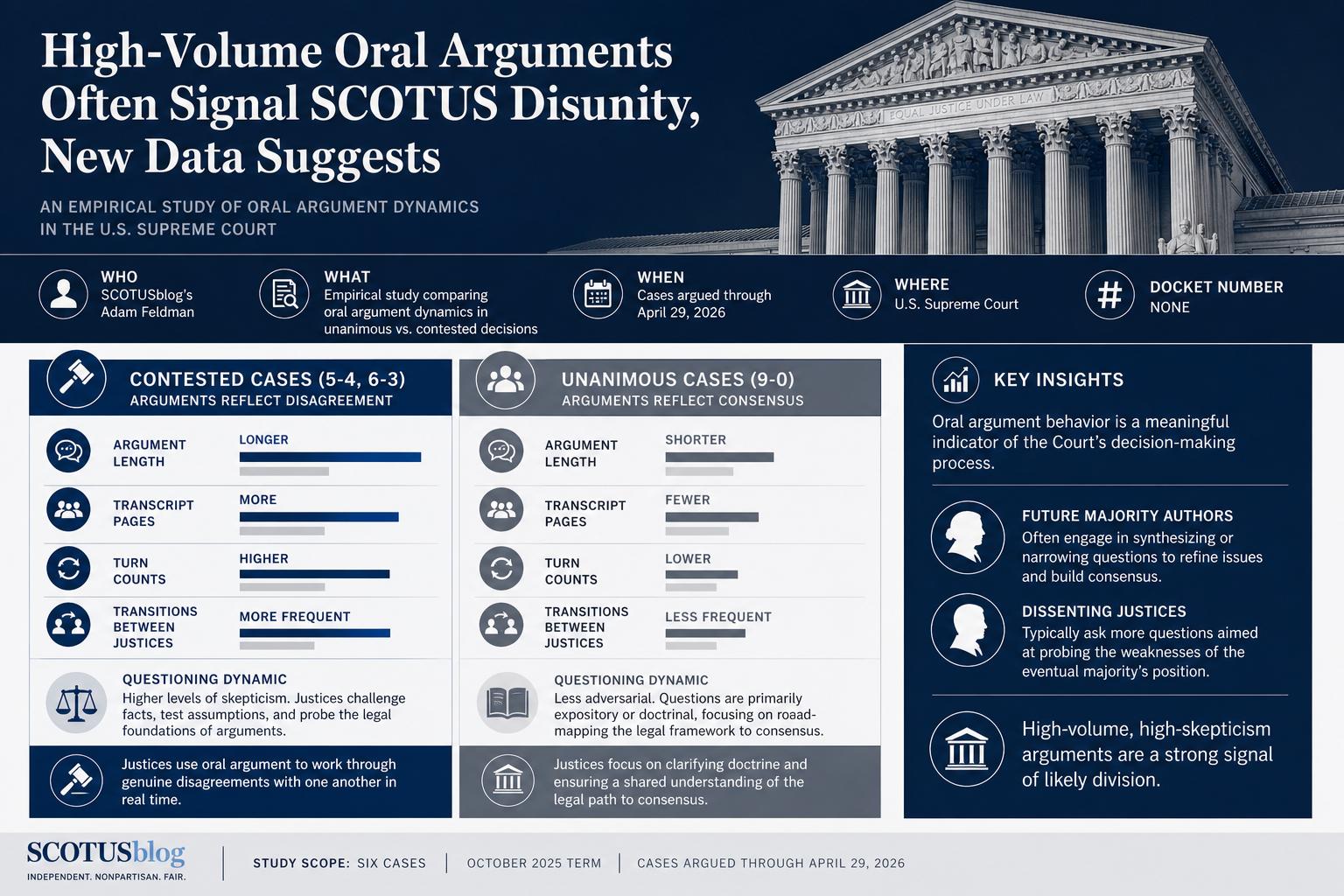
* **Who:** SCOTUSblog’s Adam Feldman analyzed the judicial behaviors of the U.S. Supreme Court during the October 2025 Term.
* **What:** An empirical study comparing oral argument dynamics in unanimous versus contested decisions.
* **When:** The study covers cases argued through April 29, 2026.
* **Where:** U.S. Supreme Court.
* **Docket Number:** NONE.
THE LEGAL BREAKDOWN:
The study analyzes six cases to determine if oral argument behavior predicts the court’s eventual division. The research highlights two distinct patterns:
1. **Contested Cases (5-4, 6-3):** These arguments are significantly longer, featuring more transcript pages, higher turn counts, and more frequent transitions between justices. The questioning is characterized by higher levels of skepticism and challenges to the legal foundations of the arguments. This indicates that justices are using oral arguments to work through genuine disagreements with one another in real time.
2. **Unanimous Cases (9-0):** These arguments involve less adversarial pressure and fewer skeptical questions. The questioning is primarily expository or doctrinal, focusing on “road-mapping” the legal framework to reach a consensus.
The report concludes that oral argument serves as a meaningful indicator of the court’s decision-making process. While future majority authors often engage in “synthesizing” or narrowing questions, dissenting justices typically ask more questions aimed at probing the weaknesses of the eventual majority’s position.